
Parking Basement Ventilation Systems in the Philippines: Design, Compliance, and Best Practices
Parking Basement Ventilation Systems in the Philippines: Design, Compliance, and Best Practices
Engineer Jon Gapuz
1/27/20262 min read
Introduction
Basement and parking ventilation is a critical safety and compliance requirement for commercial buildings in the Philippines. Unlike open-air car parks, enclosed parking basements accumulate carbon monoxide (CO), heat, exhaust fumes, and smoke, posing serious health and fire risks if not properly ventilated.
This article explains:
Why parking basement ventilation is essential
Common system types used in the Philippines
Code and safety considerations
Best practices for efficient and compliant design
Why Parking Basement Ventilation Is Required
Vehicle exhaust contains harmful gases, particularly carbon monoxide, which is colorless, odorless, and potentially fatal at high concentrations.
Without proper ventilation, parking basements can experience:
Dangerous CO buildup
Excessive heat accumulation
Poor air quality for drivers and building occupants
Non-compliance with fire and building regulations
In commercial developments such as malls, offices, hospitals, condominiums, and mixed-use buildings, parking ventilation is not optional — it is a life-safety system.
Common Parking Basement Ventilation Systems in the Philippines
1. Mechanical Exhaust & Supply Ventilation
This traditional approach uses:
Exhaust fans to remove polluted air
Fresh air supply fans to introduce clean air
While effective, ducted systems can:
Occupy significant ceiling space
Increase installation and maintenance costs
Reduce headroom in low-clearance basements
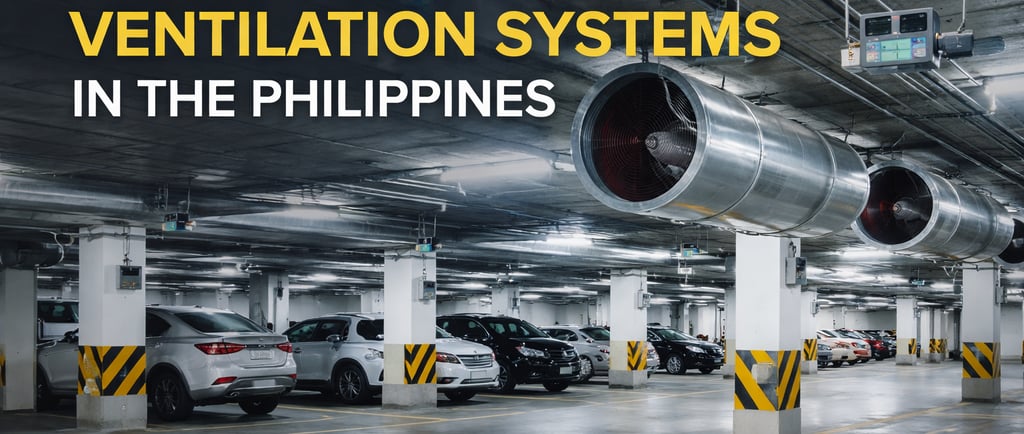
2. Jet Fan Ventilation Systems (Most Modern Approach)
Jet fan systems are increasingly used in Philippine parking basements due to their efficiency and flexibility.
How jet fans work:
Induction jet fans create directional airflow
Contaminated air is pushed toward exhaust points
Minimal or no ductwork is required
Advantages:
Lower installation cost
Better airflow distribution
More parking space due to reduced ducting
Easier retrofit for existing buildings
Jet fan systems are ideal for medium to large parking basements and are widely adopted in modern developments.
3. CO Sensor-Controlled Ventilation
To improve energy efficiency, parking ventilation systems are often integrated with carbon monoxide (CO) sensors.
Benefits:
Fans operate only when CO levels exceed safe limits
Reduced energy consumption
Automatic compliance with indoor air quality standards
This demand-controlled approach is especially important for 24/7 commercial buildings.
Fire & Smoke Extraction Considerations
In the event of a fire, parking ventilation systems play a vital role in:
Smoke extraction
Maintaining visibility for evacuation
Supporting fire brigade operations
Well-designed systems account for:
Emergency exhaust capacity
High-temperature fan ratings
Integration with fire alarm systems
Parking ventilation must be designed with both normal operation and emergency scenarios in mind.
Code & Compliance in the Philippine Context
Parking basement ventilation systems must comply with:
Philippine Building Code requirements
Fire safety regulations
Acceptable indoor air quality standards
Key design considerations include:
Minimum air change rates
CO concentration thresholds
Redundancy and fail-safe operation
Failure to meet these requirements can lead to project delays, failed inspections, or safety violations.
Best Practices for Parking Basement Ventilation Design
A properly engineered system should:
Be customized to the basement layout and ramp configuration
Use airflow simulations to eliminate dead zones
Balance performance with energy efficiency
Allow for easy maintenance and monitoring
Early coordination with architects, fire consultants, and building engineers is critical for success.
Why Professional Design Matters
Parking ventilation is not a plug-and-play system. Poor design can result in:
Ineffective airflow
Excessive operating costs
Safety and compliance risks
Engaging a specialist ventilation contractor ensures:
Proper system sizing
Code-compliant design
Long-term reliability
Parking Basement Ventilation Solutions in the Philippines
VentilationPH provides end-to-end parking basement ventilation solutions, including:
System design and engineering
Jet fan and mechanical ventilation systems
CO monitoring and control integration
Installation, testing, and maintenance
Whether for new construction or retrofit projects, a properly designed ventilation system ensures safety, efficiency, and compliance.
Talk to a Parking Ventilation Specialist
If you are planning or upgrading a parking basement ventilation system in the Philippines, professional guidance can make a significant difference.
👉 Contact VentilationPH for a site assessment and ventilation system consultation.
Expertise
Providing reliable ventilation solutions for your needs.
CONTACT US:
Testimonials
E-mail: sales@ventilationph.com
(02) 7002 - 1172
(0961) 539-3840
(0977) 142-0492
© 2024. All rights reserved.
QC: Megastate Building, 737 G. Araneta Ave, Quezon City
Makati: 156 H.V. Dela Costa Street, Makati City
Davao: J.P. Laurel Ave, Bajada, Davao City
*** Photocredits: JG; FSantos, Unsplash